

Most major platforms operate some version of a paid partnership label. A creator posts commercial content, a flag attaches to the post, and the post visibly declares itself as sponsored. This is the baseline mechanism for creator advertising transparency on social platforms, and the one regulators cite when asked how sponsored content can be distinguished from organic posting.
Under the DSA, this mechanism rests on Article 26(2). The provision requires online platforms to offer users a functionality for declaring that content is or contains commercial communication, and to ensure that declaration is visible to other users in a clear, unambiguous, real-time manner, including through prominent markings. That is the full extent of the obligation. The provision does not require the platform to validate the commercial party, nor to ensure the identification is substantively useful.
Implementations vary across platforms. Meta requires the creator to select the sponsoring brand from a list tied to a verified business account. TikTok's branded content toggle operates on the same principle. In both cases the sponsor is a structured field, backed by a verified account that already exists in the platform's records. This is a platform design choice rather than a DSA requirement, since Article 26(2) does not demand it. The choice nonetheless makes the disclosure functional rather than ornamental: a researcher, a journalist, or a regulator can resolve "who paid for this post" directly from the record.
Snapchat's implementation departs from this pattern. The Paid Partnership label exists, and posts carrying it are exposed publicly through Snapchat's Ads Gallery API. The metadata includes a sponsor_name field, which is free text entered by the creator at the moment of tagging, with no validation against any list of verified advertisers.
In practice, the field accepts whatever the creator types: an emoji, the word "ads", the creator's own name, or nothing at all.
I have built a tool that indexes the full set of creator content Snapchat exposes under this label. The results are worth examining in detail, because the sponsor field is the element that gives the label its substantive function.
The Snap Organic Content Index
The Snap Organic Content Index collects and indexes all creator content exposed through Snapchat's sponsored_content API endpoint. These are creator-posted Spotlights and Stories for which the creator has activated the Paid Partnership toggle. The API paginates through the full catalogue in alphabetical order and requires no authentication.
The dataset currently covers approx 100.000 creators for 300.000 posts carrying the Paid Partnership label. Each post carries a sponsor name where provided, a content URL, a thumbnail, and the creator's public profile URL. All figures in this post are derived from that dataset.
The label is visible only in the app
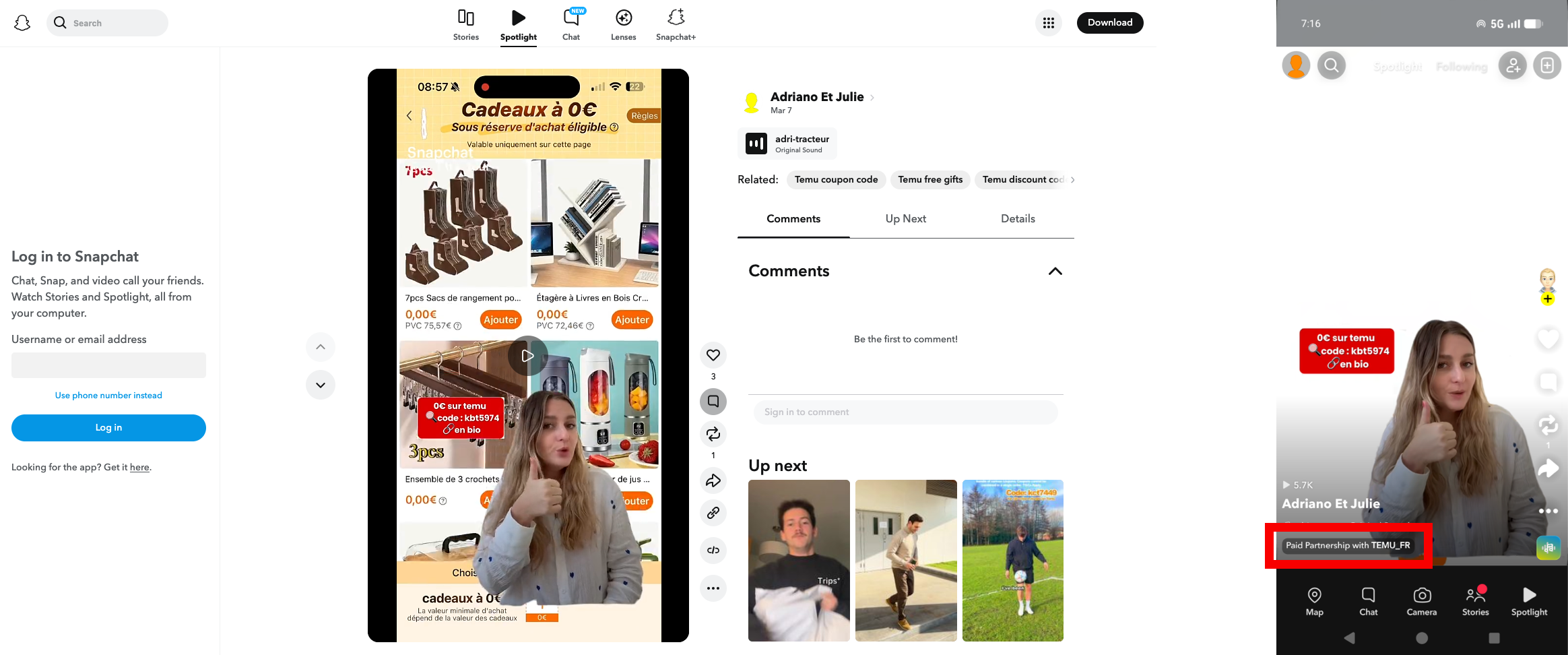
A preliminary observation is worth making before examining the sponsor field itself. The Paid Partnership marking appears on posts viewed through the Snapchat mobile application. It does not appear on the public web surface where the same stories are freely accessible. A viewer watching a tagged post in the iOS or Android app sees a disclosure; a viewer opening the same story in a browser sees none.
This is directly relevant to Article 26(2), which requires the disclosure to be identifiable in a clear, unambiguous manner and in real time, including through prominent markings, by recipients of the service. The obligation is not restricted to a particular client. Snapchat stories on the web are a user-facing surface that EU users reach, and the marking the DSA requires is not present there. EY audit examined tag availability in the iOS and Android applications; the web surface does not appear to have been within its scope.
The field is mostly empty
Of the 96,322 creators in the dataset, 5,639 declared a sponsor name. That represents 5.9%.
The remaining 90,683 creators tagged their posts as commercial sponsorship without identifying the brand. They activated the label. They triggered the "Paid Partnership" disclosure that viewers see on the post. They left blank the field that would have identified who was paying them.
This is not an edge case but the overwhelming majority of the dataset. The sponsor field is structurally optional, and in practice most creators treat filling it as unnecessary.
Posts by creators who did declare a sponsor represent 14.3% of tagged content (42,257 of 295,505). Approximately 85% of tagged posts therefore carry a disclosure that signals "this is sponsored" and nothing more.
When it is filled, the field is chaos
4,382 unique sponsor names appear in the dataset. Of these, 3,775 (86%) are associated with a single creator, and a further 377 with exactly two. The long tail dominates: only 41 sponsor names reach eleven or more creators.
The names are not consistent with the contents of a verified advertiser list. 1,348 are Arabic script only (30.8%); 2,502 are Latin script only (57.1%); 189 use a bilingual convention with a pipe separator (Segadty | سجادتي, فوندو | FUNDO); 129 mix scripts without a separator; and 214 consist of something else entirely, including emoji, symbols, and decorative characters.
Approximately 83 entries are structurally suspicious on inspection: 49 consisting of one or two characters, 25 comprising emoji only, 4 numeric-only entries, and 5 that read as placeholders. None of these would survive validation against a verified advertiser list.
Fragmentation compounds the problem. The same brand recurs under multiple spellings because no normalisation layer sits in front of the field. "Clara" appears as both Clara and CLARA; "naif" as naiF and naif; COCO 🥥 and Coco are the same brand entered twice. The Arabic content-creator tag صانع محتوى appears in three different spacings. Any accurate reach figure for these brands requires a deduplication pass that the platform itself does not perform.
39% of sponsor names are single-word entries, many of which are not brand names at all. They function as tags: ads, adv, اعلان (the Arabic for "advertisement"), personal names, country flags paired with a word. The field is in practice being used as a freeform commercial annotation rather than as a sponsor identifier.
Some declared sponsors are not sponsors
Even when the sponsor field is filled, the commercial relationship it describes is not always what the label implies. The dataset contains posts declared under temu_arabia (21 creators), TEMU_FR (24 creators), ShopTemu (10 creators), TEMU_EUROPE (2 creators), TEMU UK (1 creator), and TEMU_NL (1 creator). These are not posts paid for by Temu in the sense of a sponsored partnership. They are creators participating in Temu's affiliate programme and declaring their referral-driven content as commercial communication.
The categorisation is not strictly incorrect. Affiliate marketing is a commercial communication under EU consumer law, and using the Paid Partnership toggle to disclose it is a defensible reading of the instruction. It is, however, a different commercial relationship from a sponsored post. A sponsored post is paid for in advance, typically against specified deliverables; an affiliate post earns commission on conversions, with no direct contractual arrangement between the brand and the individual creator.
From the dataset's point of view, this distinction is invisible. The sponsor_name field returns the same value whether the creator was paid a flat fee, paid a percentage, or paid nothing but given a referral code. A regulator looking at the data cannot tell which of these economic structures lies behind any given post. The label collapses commercial relationships that other platforms handle through distinct affordances into a single free-text field with no taxonomy.
Reach is concentrated and regional
The sponsors with meaningful creators reach are not global brands. They are regional services, heavily concentrated in the MENA market and particularly in Saudi Arabia.
The top declared sponsor by creator count is a Saudi dental clinic group (مجموعة عاجي لطب الاسنان), appearing with 67 distinct creators. The second is a cleaning service (Clean Life), the third a carpet retailer (Segadty). The remainder of the top ten includes عمل خيري (literally "charity work", not a brand), oud and perfume retailers, and a taxi service. Trendyol, a Turkish e-commerce platform, is the sole internationally recognisable name in the top ten.
One consequence of this distribution merits attention. The DSA's territorial scope covers EU users, yet the disclosure-tagged commercial creator ecosystem Snap exposes is overwhelmingly MENA-facing. This does not remove Snap's Article 26(2) obligation, since EU users see this content too and the sponsored_content endpoint is global. It does, however, mean that the Paid Partnership surface and the Article 39 ads repository (covering the paid advertisements Snap sells directly into the EU market) expose two distinct commercial ecosystems. A researcher examining one without the other obtains a misleading picture of commercial content on the platform.
Why the field matters
Snapchat was designated a Very Large Online Platform under the DSA in April 2023. The Paid Partnership label is the mechanism through which the service implements Article 26(2), the provision requiring online platforms to offer users a functionality for self-declaring commercial content and to render that declaration visible. Snap's DSA audit, conducted by EY, reviewed the implementation by examining tag availability in the iOS and Android applications and confirmed that declared posts carry a visible marking. That is what 26(2) asks for at the app level, and by that measure the app-side implementation complies. The web surface, as noted above, is a separate matter.
That compliance is best assessed in the context of the surrounding regulatory architecture. Article 26(1), which governs platform-served advertising, requires recipients to be able to identify the advertiser and, where different, the natural or legal person who paid for the advertisement. That identification is mandatory. For creator-declared commercial content under 26(2), the equivalent identification, namely the element that answers "who paid for this post", is not required. The sponsor name field in the Ads Gallery API reflects this asymmetry. The information is structurally available in the data model; the law does not require it to be filled.
The DSA does not operate in isolation. Beneath it sits the Unfair Commercial Practices Directive, whose Annex I, point 11 prohibits editorial content that has been paid for without a clear statement of its commercial intent. For the purposes of EU consumer law, the influencer is a trader. A sponsor field populated with "ads", an emoji, or the creator's own name does not satisfy the UCPD baseline, regardless of whether it satisfies Article 26(2). The UCPD obligation attaches to the creator and to the brand rather than to the platform. The platform nonetheless designs the affordance through which the obligation can be met or not met.
The forthcoming Digital Fairness Act is expected to address this gap. In the meantime, the DSA's creator-disclosure provision is being complied with at the level of the label and not at the level of the sponsor, because that is what the provision requires.
This is not a novel problem. Every structured-data transparency mechanism depends on its fields being both fillable and filled. Where the field is optional and the platform neither enforces nor normalises it, the resulting transparency is formal rather than functional. The label exists. The researcher has something to read. The answer to "who paid for this post" is, in the majority of cases, not in the record.
The tool
The Snap Organic Content Index is live, and the full dataset is indexed and searchable. The dashboard is organised into three tabs: creators (with script filtering for Latin, Arabic, and emoji-only names), sponsors (aggregated from the index, sortable by creator reach), and analytics (the breakdown presented above, computed client-side from the same data that feeds the other two tabs). The index is rebuilt daily from Snapchat's public API.
Should Snapchat elect to normalise the sponsor field, validate it against a list of verified advertisers, require it to be non-empty whenever the Paid Partnership label is used, and render the marking visible on the web surface alongside the app, the analysis above would become obsolete. That would be the correct outcome. The remediation is not technically novel: Snap already operates a verified advertiser database for the paid advertisements it sells directly, which is what populates its Article 39 repository. Connecting the 26(2) disclosure surface to that same list, and propagating the marking across the web, are product decisions rather than engineering questions. Until those decisions are taken, the dataset remains what it is: mostly empty.